
Blog
Company Formation in Luxembourg 2026: SARL, Costs and Tax Guide
Company formation in Luxembourg in 2026: SARL, SARL-S and SA compared, the 2 June 2026 deferred capital reform, itemised costs, the 23.87% aggregate tax rate, corporate banking, and apostille, CFC and tax-treaty notes for founders based in Türkiye.
World Company Setup
For Tailored Solutions Free Consultation

Schedule an Online Meeting or Contact Us
Our experts will contact you within 12 hours.
Company formation in Luxembourg in 2026: SARL, SARL-S and SA compared, the 2 June 2026 deferred capital reform, itemised costs, the 23.87% aggregate tax rate, corporate banking, and apostille, CFC and tax-treaty notes for founders based in Türkiye.
Company Formation in Luxembourg 2026: SARL, Costs and Tax Guide
Setting up a company in Luxembourg became noticeably easier in 2026 for founders who run the file from Türkiye. For SARLs incorporated from 2 June 2026, payment of the €12,000 minimum share capital can be deferred for up to 12 months, a SARL-S can be formed with €1 of capital and no notary, and the aggregate corporate tax rate in Luxembourg City stands at 23.87%. Below you will find the company types, the step-by-step incorporation process, itemised 2026 costs, tax rates, the realities of corporate banking, and the apostille, CFC and tax-treaty points that founders resident in Türkiye need to plan for. Every figure on tax rates, fees and legislation was verified on 2 November 2026 against Guichet.lu, PwC, Deloitte and Arendt publications.
Last updated: November 2026 · Reading time: 14 minutes
Why Form a Company in Luxembourg in 2026
Luxembourg is a founding member of the European Union, sits at the centre of the euro area and had a population of roughly 691,000 on 1 January 2026. Almost half of its residents are foreign nationals; French, German and Luxembourgish are the official languages, while English is used widely in business. Entrepreneurs and holding structures choose Luxembourg for concrete reasons:
- Direct access to the EU single market: a Luxembourg company can sell goods and services freely in all 27 member states and obtain an EU VAT number. The mechanics are explained in VAT registration number: what it is and how to obtain it.
- A falling corporate tax rate: corporate income tax was cut from 17% to 16% as of tax year 2025, and the 2027 budget bill presented on 7 October 2026 proposes a further one-point reduction. The standard VAT rate of 17% is the lowest in the EU.
- Holding regime: under the participation exemption, dividends and capital gains from qualifying shareholdings can be exempt from corporate tax. That is why the SOPARFI is one of Europe's most widely used holding models.
- Treaty network: according to Deloitte's 2026 summary, Luxembourg has 88 double tax treaties in force; the treaty with Türkiye has applied since 1 January 2006.
- Stability and reputation: an AAA credit rating, a predictable legal system and the position of the world's second-largest investment fund centre build trust with banks and investors.
Luxembourg is not an offshore jurisdiction. Business permits, KYC/AML screening, economic substance and beneficial-owner filings are enforced strictly. For a founder with the right expectations, those rules are not an obstacle but a source of credibility with European counterparties. Other options on the continent are compared in best countries to start a business in Europe.
Luxembourg Company Types: SARL, SARL-S, SA and SOPARFI
The vast majority of foreign founders choose one of three forms. The decision depends on capital, shareholder structure, investor plans and the nature of the activity.
| Company type | Minimum capital | Notary | Shareholders | Best suited to |
|---|---|---|---|---|
| SARL (Société à responsabilité limitée) | €12,000 — cash payment can be deferred up to 12 months for incorporations from 2 June 2026 | Required | 1–100; natural or legal persons | SMEs, service and technology companies, the standard choice for foreign investors |
| SARL-S (simplified SARL) | €1 – €12,000 | Not required (private deed) | 1–100; natural persons only | Low-budget start-ups and freelancers; business permit required before registration |
| SA (Société anonyme) | €30,000 — at least 25% paid at incorporation | Required | At least 1 | Projects planning investor rounds, free share transfers or a listing |
| SOPARFI | In SARL or SA form | Depends on form | Depends on form | Holding and financing structures; benefits from the participation exemption |
Know the limits of the SARL-S: according to Guichet.lu, a SARL-S may never have a company as a shareholder, a natural person may hold shares in only one SARL-S at a time, and the company must change its legal form once its capital exceeds €12,000. A business permit is a precondition for registering a SARL-S with the RCS. Projects that will take in corporate shareholders, raise capital or scale therefore start directly with a SARL; the SARL-S suits one-person service businesses and test phases.
Documents Required to Form a Luxembourg Company
The incorporation file consists of four blocks. The notary, the Ministry of the Economy and the banks review these documents under the KYC/AML framework; missing or non-apostilled documents are the most common cause of delay in files run from Türkiye.
Documents for founders and managers
- Passport copy (notarised and apostilled)
- Proof of address from the last 3 months (utility bill or bank statement)
- CV with diplomas and professional qualification documents
- Criminal record extract (apostilled, with sworn translation)
- Source-of-funds declaration and supporting documents
Company documents
- Company name (uniqueness check with the Luxembourg Business Registers)
- Draft articles of association: business object, capital, management and representation
- Registered office in Luxembourg; a domiciliation service can be used
- Business plan and 1–3 year revenue projection (for the bank and some permit applications)
Business permit (autorisation d'établissement) file
- Issued by the Ministry of the Economy for commercial, craft, industrial and certain liberal activities; a €50 stamp duty applies.
- Guichet.lu lists three conditions: the applicant's professional integrity (honorabilité), professional qualification suited to the activity, and physical premises in Luxembourg suited to the activity. Effective and permanent management by the permit holder and compliance with tax and business obligations are also required.
- For a complete file the decision period is at most 3 months; if no answer is given in that period, the permit is deemed granted.
- A pure holding (SOPARFI) activity is not a commercial activity and does not require a business permit.
Post-incorporation registrations
- RCS (Trade and Companies Register) registration and publication in the RESA
- RBE (Register of Beneficial Owners) filing within 1 month of RCS registration; failure to file carries fines of €1,250 to €1,250,000
- Registration with the tax authority (ACD) and the VAT authority (AED)
- CCSS social security registration (if there are employees or a self-employed manager)
Luxembourg Company Formation in 8 Steps
With a complete file, SARL-S and SARL registration is usually completed within a few weeks; the statutory decision period for the business permit is 3 months, but it is normally shorter in practice. The two variables that set the overall timeline are the business permit and the bank account.
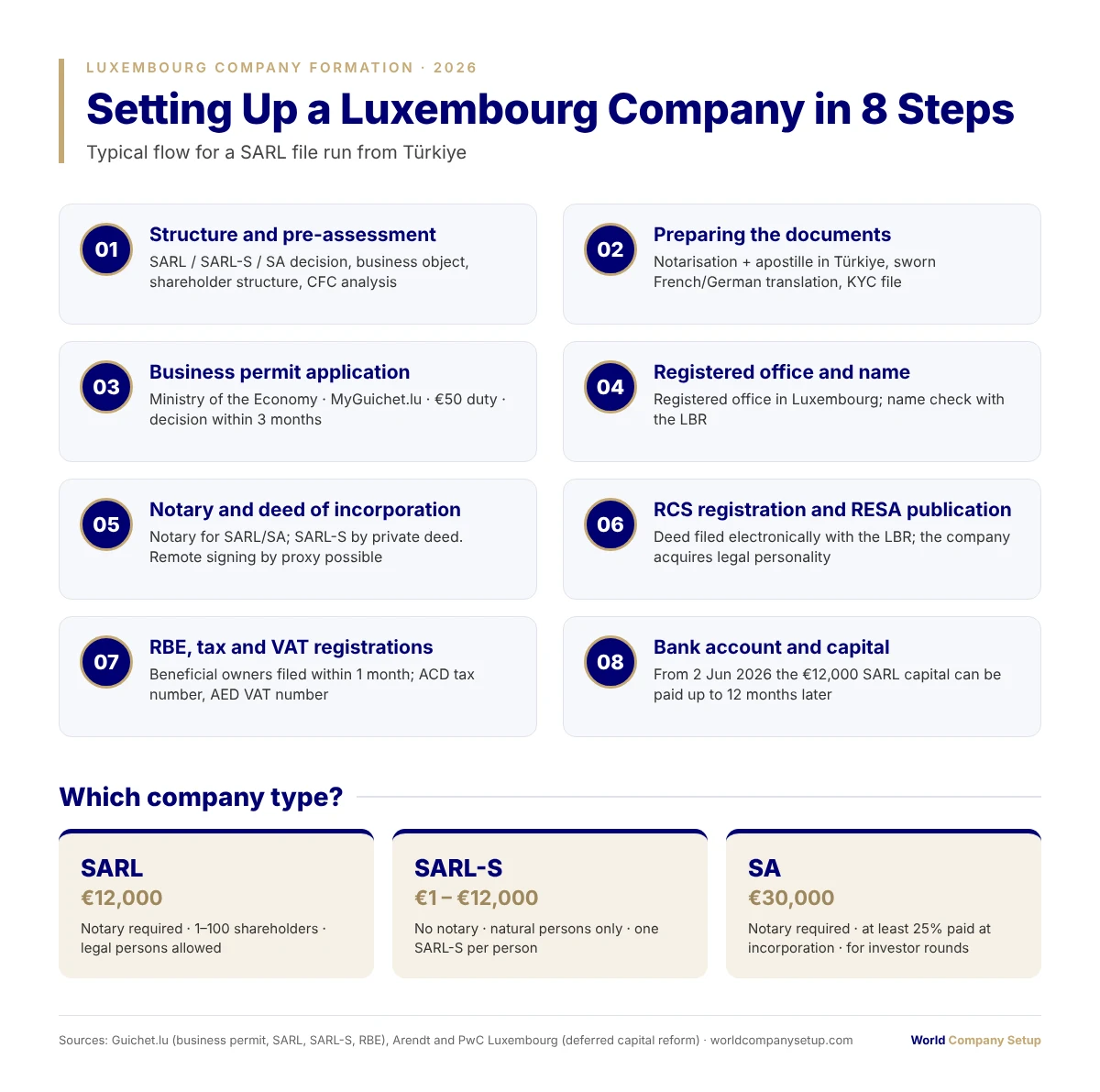
- Structure and pre-assessment. Activity, shareholder structure, target market and tax plan are defined; the SARL / SARL-S / SA decision is taken. For shareholders resident in Türkiye, the CFC (controlled foreign company) impact is calculated at this stage.
- Preparing the documents. Passport, criminal record, diplomas and specimen signature are notarised and apostilled in Türkiye, then translated by a sworn translator into French or German.
- Business permit application. The file is submitted to the Ministry of the Economy via MyGuichet.lu with a LuxTrust certificate or through a representative in Luxembourg. For a SARL-S the permit must be obtained before registration.
- Registered office and name. A registered office in Luxembourg is arranged and the name is checked with the LBR.
- Notary and deed of incorporation. SARL and SA deeds are signed before a Luxembourg notary; remote signing by proxy is possible. A SARL-S is formed by private deed.
- RCS registration and RESA publication. The deed is filed electronically with the LBR and the company acquires legal personality.
- RBE, tax, VAT and CCSS registrations. Beneficial owners are filed with the RBE within 1 month; a tax number and, where needed, an EU VAT number are obtained.
- Bank account and capital. Because cash capital of SARLs incorporated from 2 June 2026 can be paid up to 12 months later, the company can be registered before a bank account exists; the registered company then applies to a bank or an EMI.
SARL Deferred Capital Reform: What Changed on 2 June 2026
The Law of 18 May 2026 (Bill 8669) was published in the Official Journal on 29 May 2026 and applies to SARLs and SARL-S incorporated from 2 June 2026. It amends the Law of 1915 on commercial companies to allow payment of the minimum share capital to be deferred for up to 12 months after incorporation. The aim is to speed up incorporation by removing the need for a blocked bank account before the deed is signed.
According to the summaries published by Arendt and PwC Luxembourg, the limits to keep in mind are:
- Deferral applies only to cash contributions; contributions in kind must be fully paid at incorporation.
- Capital above €12,000 and any share premium must be paid immediately at incorporation.
- The articles of association may set a shorter period than 12 months.
- Founders' liability, publicity and transparency rules remain fully in force; founders stay liable for unpaid capital.
- Shares issued in capital increases after incorporation must be fully paid when issued.
In practice the reform reverses the "bank first, company second" sequence that was the biggest bottleneck for founders working from Türkiye. Applying to a bank or an electronic money institution with a registered Luxembourg company is markedly easier than opening an account for a project that does not yet exist.
Cost of Setting Up a Company in Luxembourg 2026
Excluding share capital, the official and mandatory costs of a SARL incorporation stay within roughly €1,500–3,000 in most files. The table below shows 2026 ranges for a typical service company; the duties are official amounts, while notary and service fees are indicative ranges based on Luxtoday's March 2026 market survey.
| Item | Amount (€) | Note |
|---|---|---|
| Business permit stamp duty | 50 | Ministry of the Economy; official amount |
| Notary fee and deed of incorporation | SARL 1,000 – 2,500 · SA 3,000 – 5,000 | Varies with capital; none for a SARL-S |
| RCS registration and RESA publication | 100 – 200 | Electronic filing; late filings carry €50–500 surcharges |
| Registered office / business centre | 200 – 400 / month | Kirchberg and city-centre addresses at the upper end |
| Minimum share capital | SARL 12,000 (deferrable) · SARL-S 1 · SA 30,000 | A company asset, not an expense |
| Bank account opening | 300 – 1,500 + 20 – 50 / month | Traditional banks; EMIs charge 0 – 100 to open |
| Accounting and annual accounts | 1,500 – 3,000 / year (dormant) · 5,000 – 12,000 / year (active) | Depends on transaction volume |
| Apostille + sworn translation (Türkiye) | 300 – 800 | Depends on the number of documents |
| Advisory and file management | On quotation | World Company Setup incorporation package |
The total first-year budget (excluding capital) lands between €5,000 and €10,000 in most files. For holding (SOPARFI) structures, the minimum net wealth tax and audit requirements can raise that budget. Founders based in Türkiye should also check whether part of the set-up cost qualifies for support under the Ministry of Trade incentives for establishing companies abroad.
Luxembourg Corporate Tax and Tax Rates 2026
For a company based in Luxembourg City with taxable profit above €200,000, the aggregate tax rate in 2026 is 23.87%. According to the 2026 summaries from PwC and Deloitte, that rate has three components:
| Tax | Rate (2026) | Notes |
|---|---|---|
| Corporate income tax (CIT) | 16% (above €200,000) · 14% (below €175,000) | €175,000–200,000: €24,500 + 30% of the excess. The 2027 budget bill proposes a one-point cut |
| Unemployment fund contribution (solidarity surtax) | 7% of CIT | Effective CIT 17.12% |
| Municipal business tax | 6.75% (Luxembourg City) | 6.75%–10.5% depending on the municipality |
| Aggregate (Luxembourg City) | 23.87% | 22.80% if the 2027 bill is enacted |
| Standard VAT | 17% | Lowest in the EU; reduced rates 14%, 8%, 3% |
| Net wealth tax | 0.5% (up to €500 million) | Minimum €535 – €32,100 |
| Dividend withholding tax | 15% | Reduced or eliminated under treaties and the EU Parent-Subsidiary Directive |
Participation exemption: dividends and capital gains from shareholdings of at least 10%, or with an acquisition price of €1.2 million for dividends and €6 million for capital gains, held for an uninterrupted 12 months, can be exempt from corporate tax. The 2027 budget bill proposes raising the minimum holding period for certain capital gains exemptions from six to twelve months and abolishing the 17-year limit on loss carryforwards.
Global minimum tax (Pillar Two): the 15% minimum tax rules apply to Luxembourg entities of groups with consolidated annual revenue above €750 million; SMEs are not affected. Our international tax advisory service covers structuring, and rates across jurisdictions are compared in countries with the lowest taxes.
Opening a Corporate Bank Account in Luxembourg
The bank account is the most time-consuming step of a Luxembourg incorporation and can take anywhere from a few weeks to two months. Banks want documented evidence of the company's real connection to Luxembourg (manager, office, client base) and of the source of funds.
- Traditional banks: high trust and reputation; in-person meeting or video verification; opening fees and minimum balance expectations.
- Electronic money institutions (EMIs): faster onboarding and an EU IBAN, but they may not issue a capital blocking certificate. Since the 2026 reform allows the SARL to be registered first, starting with an EMI account and moving to a bank later is a workable path.
- What strengthens the file: a business plan, first client contracts, a website and the financial statements of the founder's existing company in Türkiye.
The country-independent process is described on our international bank account opening service page and in setting up a company and opening a bank account abroad.
Forming a Luxembourg Company from Türkiye: Apostille, CFC Rules and the Tax Treaty
Turkish citizens can form a company in Luxembourg; EU citizenship is not required to be a shareholder or manager. Five points are critical in files run from Türkiye:
- Apostille and translation: passport, criminal record, diplomas and specimen signature are notarised and apostilled in Türkiye; sworn translations into French or German are requested.
- Manager and economic substance: the business permit requires the company to be managed effectively and permanently from its premises in Luxembourg. A founder resident in Türkiye should plan either a Luxembourg-resident manager or a regular physical presence.
- CFC (controlled foreign company) risk: under Article 7 of the Turkish Corporate Income Tax Law, the profit of a foreign company is taxed in Türkiye even if undistributed when Turkish-resident taxpayers directly or indirectly control at least 50% of it, at least 25% of its gross revenue is passive income, its tax burden is below 10% and its annual gross revenue exceeds the equivalent of TRY 100,000. Luxembourg's 23.87% nominal rate sits above that threshold, but holding exemptions can lower the effective rate, so the calculation must be run before the structure is set up.
- Türkiye–Luxembourg double tax treaty: signed on 9 June 2003, in force since 18 January 2005 and applied from 1 January 2006; the 2009 protocol has applied since 2012. Withholding tax on dividends is capped at 5% for companies holding at least 25% and 20% in other cases; royalties are capped at 10%. A certificate of tax residence is needed to claim treaty benefits.
- Foreign exchange and reporting obligations: capital transfers from Türkiye should be made through banks with full documentation, and the Turkish shareholder's obligation to report the foreign participation in Türkiye should be assessed.
Does a Luxembourg Company Give You a Residence Permit?
Forming a company does not grant a residence permit by itself, but it forms the basis of the self-employed (travailleur indépendant) residence permit. According to Guichet.lu, the process for non-EU nationals runs as follows: before entering Luxembourg, a temporary authorisation to stay is requested from the General Department of Immigration (valid for 90 days), followed by a type D visa; after arrival, a declaration of arrival is made at the commune within 3 days and the residence permit is applied for within 3 months. The permit is issued for up to 3 years and is renewable while the conditions continue to be met.
The assessment covers professional qualifications, the business permit where required, sufficient financial resources to run the activity and the project's contribution to the Luxembourg economy (jobs, investment, innovation); day-to-day management requires the founder's physical presence. Luxembourg has no citizenship-by-investment or "golden visa" programme. The investor residence permit is tied to an investment of at least €500,000 in an existing or new Luxembourg company (five jobs within three years for a new company), a €3 million management and investment structure, or a €20 million deposit; real estate purchases do not count.
Luxembourg vs the Netherlands vs Estonia
Turkish entrepreneurs looking at Europe most often compare these three jurisdictions.
| Criterion | Luxembourg | Netherlands | Estonia |
|---|---|---|---|
| Corporate tax (2026) | 23.87% aggregate (Luxembourg City) | 19% (up to €200,000) / 25.8% | 0% on retained profit; 22/78 of the net amount on distribution |
| Minimum capital | SARL €12,000 (deferrable 12 months) | BV €0.01 | OÜ €0.01 |
| Remote incorporation | Notary by proxy; SARL-S by private deed | Notary by proxy | Fully online via e-Residency |
| Strength | Holding and fund hub, reputation, treaty network | Trade and logistics, deep talent pool | Speed and low cost |
| Weakness | Business permit and substance requirements | High operating costs | Limited banking and reputation; VAT 24% |
The Netherlands stands out for operational trade, Estonia for fast digital incorporation and Luxembourg for holding and investment structures. See company formation in the Netherlands, company formation in Estonia, company formation in Germany and company formation in Switzerland, or browse all options under European countries.
Luxembourg Company Formation with World Company Setup
From our offices in Istanbul, Dubai, Hong Kong, Tallinn and Medina we have served more than 8,000 clients across 50+ jurisdictions. For Luxembourg, one team manages the whole process:
- Structuring advice: SARL / SARL-S / SA / SOPARFI decision and CFC analysis
- Document preparation in Türkiye: apostille, sworn translation, KYC file
- Business permit and MyGuichet.lu application
- Notary, RCS registration and RBE filing
- Bank and EMI account opening
- Post-incorporation accounting, VAT and legal consultancy
For a free initial consultation, complete the quote form or reach us through the contact page.
Sources
- Guichet.lu — Application for, or modification of, a business permit (conditions, €50 duty, 3-month decision period)
- Guichet.lu — Private limited liability company (SARL)
- Guichet.lu — Simplified limited liability company (SARL-S)
- Guichet.lu — Filing of beneficial ownership details with the Register of Beneficial Owners (RBE)
The information above is provided for general guidance and reflects the legislation in force as of 2 November 2026. Seek advice tailored to your situation before making tax or legal decisions.
FREQUENTLY ASKED QUESTIONS
Company Formation in Luxembourg 2026: SARL, Costs and Tax Guide frequently asked questions.
For a SARL, official costs including the notary, RCS registration and the business permit come to roughly €1,500–3,000 in 2026. The €12,000 minimum capital can be deferred for up to 12 months for companies incorporated from 2 June 2026. A SARL-S can be formed with €1 and no notary; the total first-year budget excluding capital is usually €5,000–10,000.
An apostilled passport and criminal record, proof of address, CV, business plan, articles of association, a registered office in Luxembourg and, for commercial activities, a business permit from the Ministry of the Economy. RCS, RBE, tax and VAT registrations follow incorporation.
Yes. EU citizenship is not required. Documents are prepared in Türkiye with apostille and sworn translation; to show that the company is effectively managed from its premises in Luxembourg, a local manager or regular physical presence should be planned for the business permit.
Incorporation does not grant residence automatically. Under the self-employed route, a temporary authorisation to stay, a type D visa and a residence permit can be applied for; professional qualifications, financial resources, the business permit and the project's economic contribution are assessed. There is no golden visa programme.
In 2026 corporate income tax is 16% (14% for profit below €175,000), the unemployment fund contribution is 7% of CIT and the municipal business tax in Luxembourg City is 6.75%, giving an aggregate of 23.87%. The 2027 budget bill proposes reducing the aggregate to 22.80%.
With a complete file, SARL and SARL-S registration is usually completed within a few weeks; the statutory decision period for the business permit is up to 3 months. The bank account can take from a few weeks to two months; since the 2026 reform allows the SARL to be formed before the bank account, the overall timeline has shortened.
Yes. The notarial deed can be signed by proxy, a SARL-S is formed by private deed and applications are filed through MyGuichet.lu. Some banks still require an in-person meeting, however, and the business permit requires management to be carried out from the company's premises in Luxembourg.
A SARL requires €12,000 capital and a notary and may have corporate shareholders. A SARL-S is formed with €1–12,000 without a notary, may only have natural persons as shareholders, is limited to one per person and needs a business permit before registration; once capital exceeds €12,000 the legal form must change.