Telephone Numbers
Telephone Numbers
For detailed information +90 542 381 3868'Call.
Almost everyone planning to launch a business in Dubai runs into the same question sooner or later: which free zone should I choose? The city is home to more than 30 free zones (over 50 across the UAE), each designed around a specific industry, budget and business model. The right choice directly affects your cost, your visa quota and even how smoothly you open a bank account.
In this guide we explain the types of Dubai free zones in plain language, compare up-to-date 2026 setup costs, and break down the tax and ownership benefits a free zone company offers.
A free zone is a special economic area with its own regulatory authority and customs regime, where foreign investors can own 100% of their company without a local partner. Dubai’s first free zone, the Jebel Ali Free Zone (JAFZA), opened in 1985. Today the city offers a dedicated free zone for almost every sector, from technology and gold to media and healthcare.
Companies in a free zone are usually registered under one of three structures: a Free Zone Establishment (FZE), a Free Zone Company (FZ-LLC), or a branch of an existing company. These structures support both single-shareholder and multi-shareholder setups.
Grouping Dubai’s free zones by the sector they serve makes your decision much easier. The main categories and their standout zones are:
A favourite among small and medium businesses thanks to its affordable pricing and flexible licensing. You can obtain e-commerce, consultancy or trading licences with a flexi-desk option and no mandatory physical office.
Named the world’s leading free zone for several years by the Financial Times, DMCC stands out for commodities, gold, diamond and crypto-asset trading. It offers prestige and broad activity coverage, though it sits at the higher end on cost.
Popular in recent years for its central location, fast setup and competitive pricing. A strong choice for trading, holding and digital business models.
Dubai’s most established free zone. Integrated with Jebel Ali Port, it is ideal for import-export, manufacturing and large-scale logistics.
A financial hub built for banks, asset managers, insurers and fintech firms. Its independent common-law judicial system makes it a trusted base for international financial institutions.
Adjacent to Dubai International Airport, it suits aviation, electronics and time-sensitive export businesses, and also allows dual licensing.
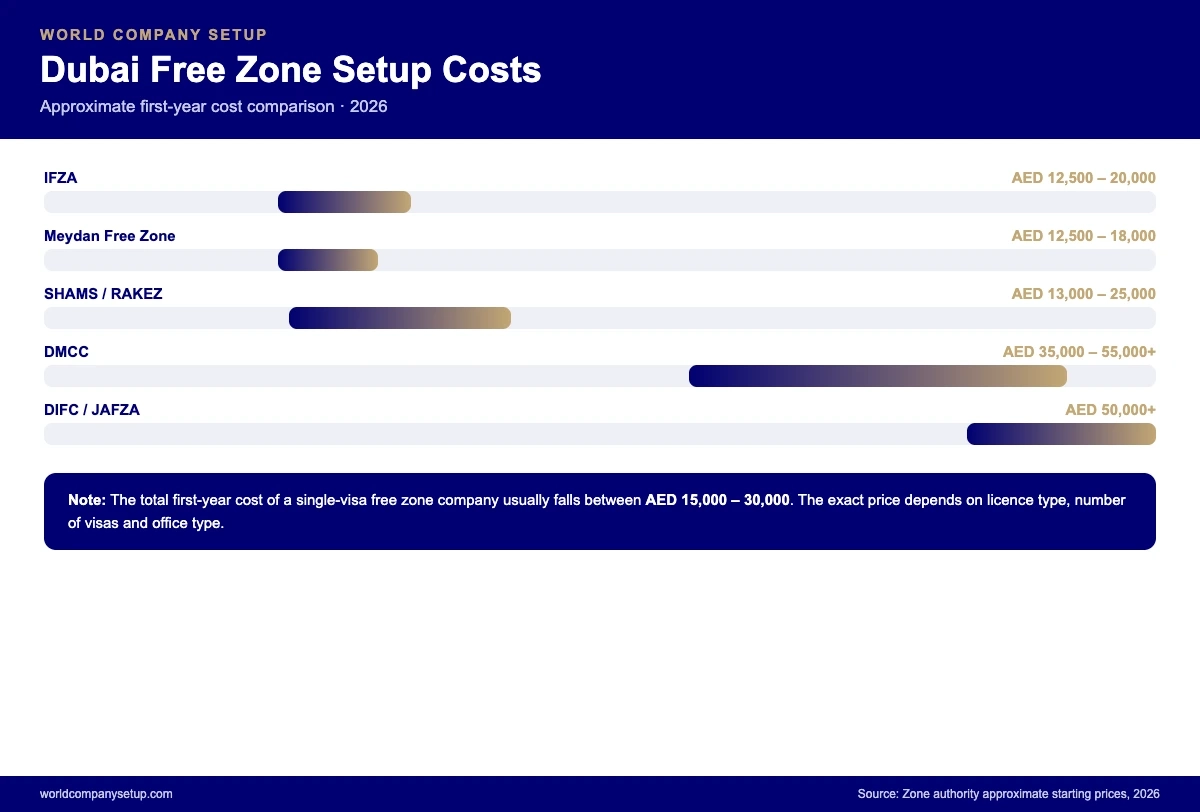
Costs vary by zone, licence type, number of visas and office type. The table below summarises approximate starting figures for 2026. The exact price depends on your chosen activity and package.
| Free Zone | Approx. First-Year Cost (AED) | Best For |
|---|---|---|
| IFZA | 12,500 – 20,000 | Cost-effective setup, e-commerce, consultancy |
| Meydan Free Zone | 12,500 – 18,000 | Trading, holding, digital business |
| SHAMS / RAKEZ | 13,000 – 25,000 | Media, freelancing, general trading |
| DMCC | 35,000 – 55,000+ | Commodities, gold, crypto, prestige hub |
| DIFC / JAFZA | 50,000+ | Finance, large-scale logistics and manufacturing |
As a rule of thumb, a single-visa free zone company typically costs between AED 15,000 and 30,000 in the first year. For a tailored quote, explore our Dubai free zone company setup service.
The UAE introduced corporate tax from June 2023. As of 2026 the framework works as follows:
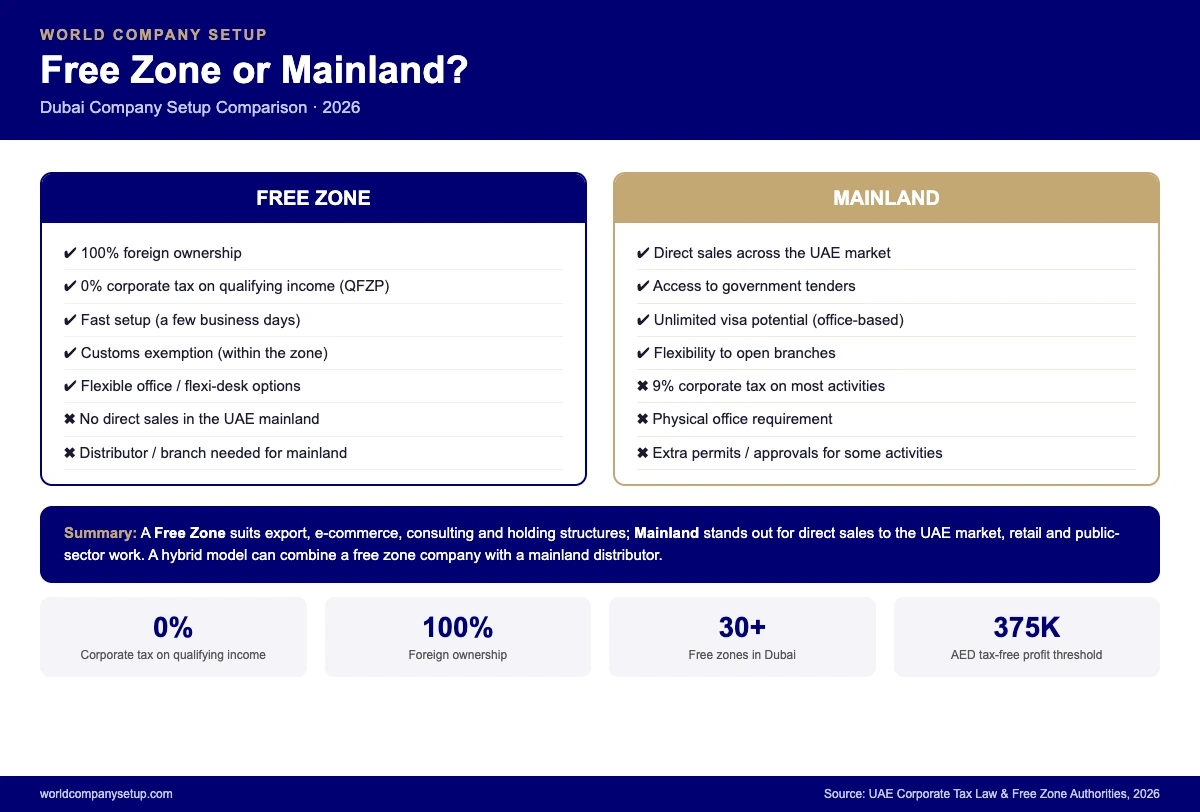
QFZP status is not automatic; it requires adequate economic substance, audited financial statements, and non-qualifying income staying within de minimis limits. If these conditions are not met, income is taxed at the standard 9%. The absence of personal income tax and capital gains tax further strengthens Dubai’s appeal.
For official information on UAE free zones, see the Invest in Dubai government portal.
100% foreign ownership: Own your company entirely and retain full management control, with no local sponsor required.
Full profit and capital repatriation: Transfer your profits and capital abroad without restrictions.
Tax advantages: 0% corporate tax on qualifying income, no personal income tax, and customs exemption within the free zone.
Fast, practical setup: Many zones issue a licence within a few business days and guide you through visa and banking steps.
Sector-specific infrastructure: Modern offices, warehouses, labs and logistics hubs tailored to each industry.
Strategic location: A geographic bridge connecting Europe, Asia and Africa for international trade.
For a step-by-step process, required documents and current costs, see our guide on setting up a company in Dubai.
There is no single “best” free zone; the right one depends on your business model. For low-budget e-commerce or consultancy, IFZA or Meydan stand out; for commodities and crypto trading, DMCC; for financial institutions, DIFC; for large-scale logistics and manufacturing, JAFZA. Visa quota, office requirements, banking ease and activity flexibility should all be weighed together.
At World Company Setup, we support you at every step, from identifying the ideal free zone to company registration, visa and bank account processes, and ongoing accounting and tax compliance. Contact us today for a personalised assessment.
Dubai free zones offer international investors a powerful base with 100% foreign ownership, 0% corporate tax on qualifying income and full profit repatriation. Choosing the zone that best fits your sector and budget is the most critical step of the setup process.
From IFZA and DMCC to Meydan, JAFZA and DIFC, making the right choice among dozens of free zones takes expertise. World Company Setup manages the entire process on your behalf – from zone selection and licensing to visas, bank accounts and tax compliance. Contact us today to set up your Dubai free zone company.
Dubai has more than 30 free zones, while the total across the UAE exceeds 50. Each zone focuses on specific sectors such as trade, technology, media, finance or healthcare.
As of 2026, a single-visa free zone company typically costs between AED 15,000 and 30,000 in the first year. Cost-effective zones like IFZA and Meydan start from around AED 12,500, while prestigious zones such as DMCC and DIFC start from AED 35,000 and up.
Yes. Free zone companies that meet specific conditions can qualify as a Qualifying Free Zone Person (QFZP) and pay 0% corporate tax on qualifying income. If the conditions are not met, profit above AED 375,000 is taxed at the standard 9% rate.
Yes. Dubai free zones allow foreign investors to own 100% of the company and retain full management control, with no local partner or sponsor required.
IFZA and Meydan Free Zone stand out as some of the most affordable, thanks to low starting costs and flexible licensing. However, the 'best value' zone depends on your business model, visa needs and type of activity.
In many free zones the licence can be issued within a few business days once the documents are complete. Including visa and bank account processes, the full setup usually takes between one and three weeks.
 +90 542 381 3868
 +971 58 5204103